How to Read a 9th Class Result Card in 2026
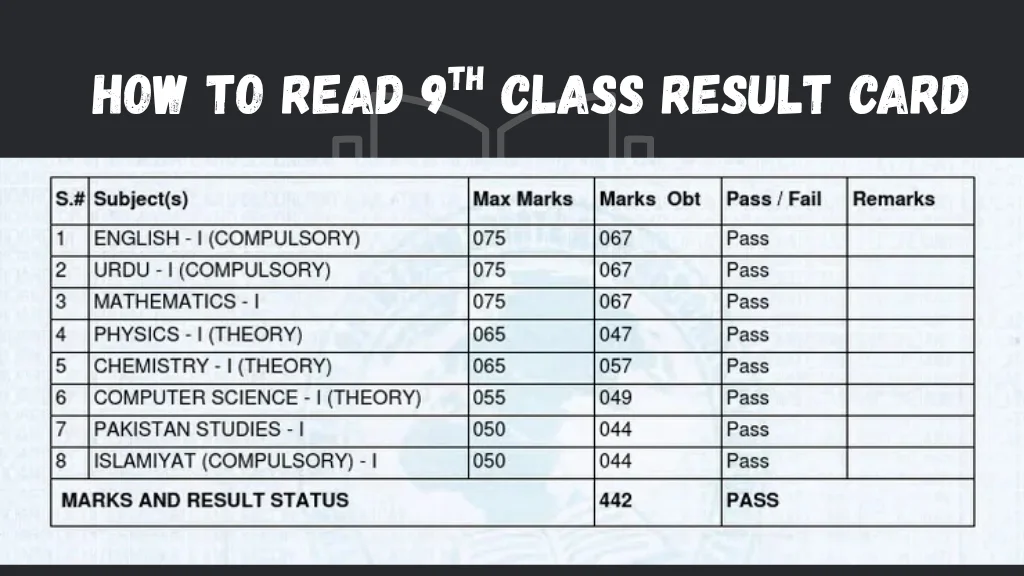
A 9th class result card contains more information than just your total marks or grade. It usually includes your name, roll number, subjects, marks or grades, examination details and overall result status. Understanding each part helps you know exactly how you performed in the examination.
The format can vary between educational boards, but the main information is generally similar. Students receiving their 9th class result in 2026 should also be aware of the new grading system introduced for Grade 9 from the First Annual Examination 2026.
If you have not check your 9th class result by roll number yet, you can use our 9th Class Result 2026 guide to find the result for your educational board.
What Is a 9th Class Result Card?
A 9th class result card is the document or result record that shows a student’s performance in the Secondary School Certificate Part 1 examination.
It provides the examination information and records the student’s performance in individual subjects. Depending on the board, it may show numerical marks, grades, grade points, result status and other candidate information.
The exact design is not the same for every board, so students should focus on understanding the information shown rather than comparing the appearance of one board’s result card with another.
Main Information on a 9th Class Result Card
When you open your result, you may see several different sections.
These commonly include:
- Student name
- Roll number
- Registration or examination number
- Father’s name or other candidate information
- Examination name
- Examination year
- Subject names
- Maximum marks where applicable
- Obtained marks or grades
- Grade points where applicable
- Result status
Not every board necessarily displays every field in the same way.
How to Read Your Name and Roll Number
The first thing you should check is your personal information.
Make sure your name and roll number match the information on your examination documents. The roll number is particularly important because it identifies your examination record.
If you notice an apparent error in your personal information, do not ignore it. Contact your school or examination board and follow the official procedure for correcting candidate information.
What Does the Examination Name Mean?
Your result may contain terms such as SSC Part 1, 9th Class, or Secondary School Certificate Part 1.
These terms refer to the first stage of the secondary school examination. In the conventional matric system, SSC Part 1 corresponds to the 9th class stage, while SSC Part 2 refers to the 10th class stage.
This is why a student looking for a 9th class result may see SSC Part 1 written on the official result record.
How to Read the Subject Section
The subject section is one of the most important parts of your result card.
Each subject you studied and appeared for in the examination may be listed separately. The result can show the subject name along with its marks, grade or other assessment information.
Do not look only at the overall result. Check each subject individually because this tells you where you performed well and where you may need improvement.
What Are Obtained Marks?
Obtained marks are the marks you actually received in a subject or examination component.
For example, if the maximum marks for a particular paper are 75 and your result shows that you obtained 60, then 60 is your obtained mark for that component.
The maximum marks can differ between subjects and examination schemes, so always use the figures shown on your own board’s result record.
What Are Maximum Marks?
Maximum marks indicate the highest number of marks available for a particular subject or examination component.
They are useful when calculating your percentage or understanding your performance.
For example, if a subject has 75 maximum marks and you obtain 60, your performance for that component can be expressed as:
60 ÷ 75 × 100 = 80%
However, do not assume that every 9th class subject carries the same maximum marks. The subject structure can vary according to the board and applicable scheme of studies.
What Does the Grade Mean?
The grade provides a standardized description of your academic performance.
For 9th class students appearing in 2026, the new national grading system uses a 10-grade scale:
| Percentage | Grade |
|---|---|
| 96%–100% | A++ |
| 91%–95% | A+ |
| 86%–90% | A |
| 81%–85% | B++ |
| 76%–80% | B+ |
| 71%–75% | B |
| 61%–70% | C+ |
| 51%–60% | C |
| 40%–50% | D |
| Below 40% | U |
The new system replaced the previous seven-grade system and applies to Grade 9 from the First Annual Examination 2026.
What Does U Mean on a 9th Class Result?
Under the 2026 grading system, U represents performance below the passing level.
The passing threshold under the new system is 40%. Therefore, a percentage below 40% falls into the U grade range.
If you see U against a subject, check your complete result and the official instructions provided by your board to understand your result status and available options.
What Is the Passing Percentage in 9th Class 2026?
The passing threshold under the new grading system is 40%.
This is an important change because older information about the previous 33% passing standard may still appear online. The new grading policy applies to Grade 9 from the First Annual Examination 2026.
Students should therefore use current 2026 information when interpreting their result.
Are Marks Still Shown on the 2026 Result Card?
Yes, during the first phase of implementation, absolute scores are also reported alongside grades for Grade 9 and Grade 11.
IBCC explains that absolute scores are being reported alongside grades during the transition so that students and other stakeholders can understand the new system.
This means students should not be confused if their 2026 result contains both numerical marks and grades.
What Is a Grade Point?
A grade point is the numerical value associated with a grade under the grading system.
Students should not automatically treat a grade point as the same thing as the percentage printed on an older result card. The 2026 system is being introduced in phases, and IBCC says that GPA has been deferred until the new grading scheme is adopted by all examination boards.
For your actual result, use the grade and grade-point information provided by your board.
What Does Result Status Mean?
Your result card may include an overall status indicating whether you have completed the examination requirements or whether there is an issue with one or more subjects.
The exact wording can differ between boards.
For example, a result may indicate a successful result, a failed subject, an absent status or another examination-related status. If you do not understand a particular abbreviation or status, check the explanation provided by your board rather than assuming what it means.
What Does Pass or Fail Mean?
The result status indicates whether you have met the relevant examination requirements.
Under the 2026 grading policy, the passing threshold is 40%. However, your overall status can also depend on your performance in individual subjects and the applicable board rules.
If you see a failed or unsuccessful status in one subject, do not assume that you must repeat the entire 9th class. Check your board’s post-result rules for the available options.
What If You Fail One Subject?
If one subject shows an unsuccessful result, your next step is to check the rules of your educational board.
Boards can provide opportunities for eligible students to reappear in failed subjects through subsequent examinations, but the exact procedure, schedule and eligibility requirements are board-specific.
If you are in this situation, read our guide on what happens if you fail one subject in 9th class to understand the possible next steps.
How to Check Your Total Marks
If your result card provides numerical marks, add the obtained marks from the relevant subjects to understand your total.
However, make sure you are using the correct subjects and maximum marks for your examination. Some subjects may have different maximum marks or practical components.
Your board’s official result record should be treated as the final source for your marks.
How to Calculate Your Percentage From the Result Card
If you want to calculate your percentage, use:
Percentage = Obtained Marks ÷ Maximum Marks × 100
For example, if you obtained 420 marks out of 550:
420 ÷ 550 × 100 = 76.36%
This calculation is useful for understanding your numerical performance, although the official grade shown by your board remains the authoritative result.
What If the Marks on Your Result Card Look Wrong?
If the marks are significantly different from what you expected, first check that you have opened the correct result record.
Verify your:
- Name
- Roll number
- Examination year
- Subject
- Marks
- Grade
- Result status
If you still believe there may be an error, check whether your board provides a rechecking or re-totaling service.
Remember that rechecking generally does not mean that your answers will be completely re-evaluated. It is normally a process for checking or re-totaling recorded marks according to the board’s rules.
What Should You Do After Reading Your Result?
Do not stop at checking whether you passed.
Review your subject-wise performance and identify the areas where you performed well and where you need improvement.
If you have passed, use your weaker subjects to plan your 10th class preparation. If there is a failed subject or you believe there is an error, check your board’s official post-result procedures.
Your result is most useful when you treat it as feedback rather than simply as a final number.
How Is a Result Card Different From a Gazette?
A result card is an individual student’s result record.
A result gazette is a broader document containing the results of many students from an examination.
If you only need to check your own marks, the individual online result or result card is usually easier to understand. A gazette is more useful when searching for multiple students, checking broader results or when an online individual result is temporarily unavailable.
Can You Use an Online Result as an Official Document?
An online result is useful for checking your examination performance, but students should follow their board’s instructions regarding official DMCs, certificates and other educational documents.
Do not assume that a screenshot or printed webpage has the same status as an official document issued by your board.
If a school, college or other institution asks for a specific document, follow its requirements and obtain the appropriate document from the board if necessary.
Frequently Asked Questions
What is a 9th class result card?
It is an individual examination record showing a student’s performance in the 9th class or SSC Part 1 examination. It can contain personal information, subjects, marks, grades and result status.
What should I check first on my result card?
Check your name, roll number, examination year and subject-wise result first. Then review your total marks, grades and overall status.
What does SSC Part 1 mean on a result card?
SSC Part 1 refers to the first part of the Secondary School Certificate examination, which generally corresponds to 9th class.
What does U mean in the 2026 9th class result?
U represents performance below the passing level under the new 2026 grading system. The passing threshold is 40%.
What is the passing percentage for 9th class in 2026?
The passing threshold under the new grading system is 40%. Grade 9 is included in the first phase of implementation from the First Annual Examination 2026.
Are numerical marks shown in the 2026 result?
During the first phase of the new grading system, absolute scores are also reported alongside grades for Grade 9 and Grade 11.
What if I do not understand my result status?
Check the explanation provided by your board or contact your school or examination board. Do not rely on an abbreviation’s assumed meaning.
What if I think my marks are incorrect?
Check your result details carefully and then see whether your board offers rechecking or re-totaling. Follow the current official procedure and deadline.
Does every board use the same result card format?
No. The layout, terminology and information displayed can vary between educational boards.
Can I calculate my percentage from my result card?
Yes, if your result provides the necessary marks. Divide your obtained marks by the maximum marks and multiply by 100.
Final Words
Reading a 9th class result card becomes much easier once you understand what each section represents. Start with your personal information, then check your subjects, marks, grades and overall result status.
For students receiving their result in 2026, pay particular attention to the new grading system and its 40% passing threshold. The first phase includes Grade 9, and absolute scores are also being reported alongside grades during the transition.
If something on your result looks incorrect or you do not understand your status, use the official information and post-result services provided by your own educational board.