How 9th Class Result Marks Are Calculated in 2026

Students often want to know how their 9th class result marks are calculated after the board examination. The basic calculation is simple, but the total marks and grading rules can differ according to the educational board, subject combination and examination scheme.
For 2026, students also need to understand an important change. Pakistan’s examination boards have started implementing the new SSC and HSSC grading system from the First Annual Examination 2026. The first phase applies to Grade 9 and Grade 11, while absolute marks are still reported alongside grades during the transition period.
How Are 9th Class Marks Calculated?
The basic percentage calculation is:
Percentage = (Obtained Marks ÷ Total Marks) × 100
For example, if a student obtains 420 marks out of a total of 550 marks, the percentage is calculated by dividing 420 by 550 and multiplying the result by 100.
The important point is that you should always use the actual total marks applicable to your board and examination scheme. You should not assume that every Pakistani board has exactly the same subject wise marks.
How Subject Wise Marks Are Counted?
Your 9th class result 2026 is based on the marks awarded in the subjects you appeared in.
The marks for each subject are recorded separately, and the obtained marks from the relevant subjects are used to determine the overall performance shown in the result.
The exact subject combination and maximum marks depend on the board and the scheme of studies applicable to your examination. For example, Punjab’s official Grade 9 Mathematics examination instructions for Annual Examination 2026 specify a 75 mark paper, divided into objective and subjective sections.
This is why students should use their own board’s result card and official examination scheme when calculating their exact total.
How to Calculate Your 9th Class Percentage?
You can calculate your percentage yourself if you know your total obtained marks and maximum marks.
Use this formula:
Percentage = Obtained Marks ÷ Total Marks × 100
For example:
| Details | Example |
|---|---|
| Obtained marks | 420 |
| Total marks | 550 |
| Calculation | 420 ÷ 550 × 100 |
| Percentage | 76.36% |
This gives you the percentage based on the marks in the example. Your own percentage will depend on the actual total marks applicable to your examination.
After calculating your marks and percentage, you can check your complete 9th Class Result 2026 through the main result guide.
How Are Grades Calculated in 9th Class Result 2026?
The grading system has changed for SSC and HSSC examinations in 2026.
According to the Inter Boards Coordination Commission, the new system uses 10 grades:
| Percentage | Grade |
|---|---|
| 96%–100% | A++ |
| 91%–95% | A+ |
| 86%–90% | A |
| 81%–85% | B++ |
| 76%–80% | B+ |
| 71%–75% | B |
| 61%–70% | C+ |
| 51%–60% | C |
| 40%–50% | D |
| Below 40% | U |
The new policy raises the passing threshold to 40%, compared with the previous 33% standard. The policy is being introduced in phases, beginning with Grade 9 and Grade 11 in the First Annual Examination 2026.
Are Marks and Grades Both Shown in the 2026 Result?
Yes. The first phase of the new grading system does not immediately remove absolute marks.
IBCC states that for Grade 9 and Grade 11 in 2026, absolute scores will also be reported alongside grades. This helps students and other stakeholders understand the new system during the transition.
This means students should not be confused if their 2026 result contains both numerical marks and a letter grade.
What Does 40% Passing Marks Mean?
Under the new grading policy, a student needs to achieve at least 40% to meet the passing threshold.
For example, if a particular subject has a maximum of 100 marks, 40 marks would represent 40%. However, the actual maximum marks for individual subjects can be different, so students should calculate the required marks according to the maximum marks of that subject.
The 40% policy applies to the new grading system introduced for the First Annual Examination 2026.
Does Every 9th Class Subject Have the Same Total Marks?
No. Students should not assume that every subject carries the same number of marks.
The maximum marks depend on the subject and the applicable scheme of studies. Some subjects can also have practical components or different theory and practical arrangements.
For example, official Punjab examination instructions for Grade 9 Mathematics for Annual Examination 2026 specify a 75 mark paper.
Therefore, the safest way to calculate your overall result is to use the maximum marks printed on your result card or the official scheme applicable to your board.
How Are Practical Marks Included?
For subjects that contain practical examinations, the practical component is handled according to the assessment scheme of the relevant board and subject.
Students should not simply add a fixed practical percentage to every subject because practical arrangements are not identical across all subjects and boards.
When calculating your final marks, use the marks actually awarded in the theory and practical components shown by your board.
How Do You Calculate Total 9th Class Marks?
To calculate your total marks, add the obtained marks from all subjects included in your 9th class examination.
For example:
| Subject | Obtained Marks |
|---|---|
| English | 70 |
| Mathematics | 65 |
| Urdu | 68 |
| Science | 72 |
| Islamiat | 75 |
| Other subjects | 70 |
| Total | 420 |
The example above is only for explaining the calculation method. Your actual subjects, maximum marks and total will depend on your board and examination scheme.
After adding your marks, compare the obtained total with the maximum total applicable to your examination.
How Is the Final Percentage Worked Out?
Once you know the total marks you obtained and the maximum possible marks, use the percentage formula.
Percentage = Obtained Marks ÷ Maximum Marks × 100
Suppose your result shows:
Obtained marks = 420
Maximum marks = 550
Your percentage would be:
420 ÷ 550 × 100 = 76.36%
You can then compare the percentage with the 2026 grading ranges published under the new national grading policy.
Does GPA Determine the 9th Class Result?
Students should not confuse the new grading system with a university style GPA system.
IBCC’s 2026 policy explains that although grades and grade points are part of the new framework, the GPA has been deferred until the new grading scheme is adopted by all examination boards. For the first phase in 2026, absolute scores are also reported alongside grades.
Therefore, students checking a 2026 9th class result should rely on the marks and grade information actually provided by their board rather than trying to convert their result into a university style GPA.
Why Can Two Students Have Different Marks but Similar Grades?
The new grading system groups percentage ranges into specific grades.
For example, under the 2026 scheme, marks between 76% and 80% fall within the B+ range, while 81% to 85% falls within B++.
This means two students can have different numerical percentages while still receiving the same letter grade if their percentages fall within the same range.
The numerical marks remain useful because they show the student’s exact performance, while the grade provides a standardized description of that performance.
What If Your Result Shows Unexpected Marks?
If the marks shown on your result are significantly different from what you expected, first check the complete result carefully.
Make sure you are viewing the correct roll number and examination record. Then check the subject wise marks rather than judging the result only from the overall total.
If you believe there is an actual error, check the official post result services offered by your educational board. Depending on the board, students may have options related to rechecking, re-totaling or other result procedures.
Does the Calculation Method Differ Between Boards?
Some basic principles are common, but students should not assume that every board uses exactly the same subject structure or maximum marks.
Punjab boards, Khyber Pakhtunkhwa boards, the Federal Board and other examination boards can have different schemes of studies and subject mark distributions.
The new national grading policy is being implemented across examination boards, but the actual subjects, maximum marks and examination arrangements still need to be checked according to the relevant board. IBCC confirms that all public and private examination boards in Pakistan are required to implement the new grading system from the First Annual Examination 2026, except foreign examination boards operating in Pakistan.
What Should Students Check on Their Result Card?
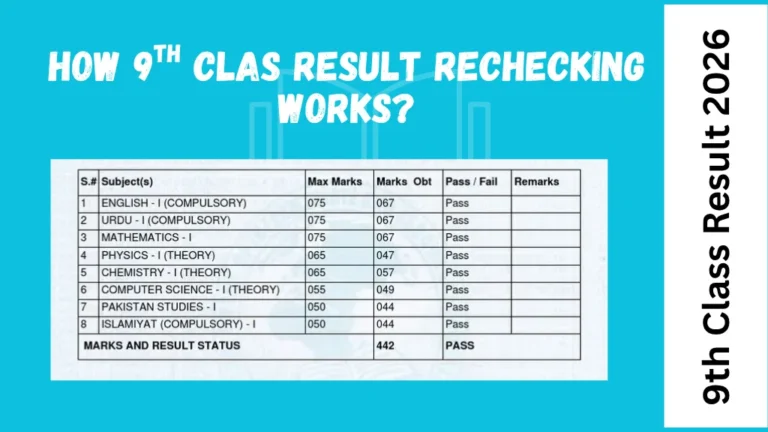
When your result is available, do not look only at the final grade. When you 9th Class Result by Roll Number, you can see the following details on result.
Check:
- Your name
- Roll number
- Each subject
- Obtained marks
- Maximum marks where shown
- Grade
- Overall result status
Looking at subject wise performance can help you identify the subjects in which you performed strongly and those that may need more attention.
Frequently Asked Questions
How are 9th class result marks calculated?
The basic percentage is calculated by dividing the marks obtained by the maximum marks and multiplying by 100. The exact maximum marks depend on the student’s board and examination scheme.
What is the passing percentage for 9th class in 2026?
The new national grading policy sets the passing threshold at 40% for the examinations covered by the new system. The policy begins with Grade 9 and Grade 11 in the First Annual Examination 2026.
What is the new grading system for 9th class 2026?
The new system uses 10 grades ranging from A++ to U, with A++ representing 96%–100% and U representing below 40%.
Are marks still shown in the 9th class result in 2026?
Yes. IBCC states that absolute scores are also reported alongside grades during the first phase of implementation in 2026.
How do I calculate my 9th class percentage?
Divide your obtained marks by the maximum marks and multiply the result by 100.
Do all 9th class subjects have the same marks?
No. Maximum marks can differ by subject and examination board. Students should use the official scheme applicable to their examination.
Does the new 2026 grading system apply to all boards?
The IBCC states that the new grading system is required for public and private examination boards in Pakistan from the First Annual Examination 2026, except foreign examination boards operating in Pakistan.
Is 9th class result 2026 based only on grades?
No. During the first phase of implementation, students also receive absolute scores alongside grades.
Can I calculate my grade from my percentage?
Yes. Once you know your percentage, you can compare it with the applicable 2026 grading range. Your board’s official result remains the final record of your grade.
Final Words
Calculating your 9th class result marks is straightforward once you know the marks obtained and the maximum marks applicable to your examination. The basic percentage formula remains obtained marks divided by total marks, multiplied by 100.
For students appearing in 2026, the new national grading system is an important change. Grade 9 is included in the first phase, the passing threshold has moved to 40%, and students receive grades alongside absolute scores during the transition.
Because subject structures and maximum marks can differ between boards, always use your own result card and the official examination scheme when checking your calculation.